
Explainers
Block Grant
The Block Grant is the main source of funding and the largest fiscal transfer from the UK Government to the Scottish Government.
It is sometimes split into two parts:
- Barnett funding. It is by far the largest of the two. It is updated every time the UK Government changes its spending plans for departments delivering devolved public services, such as healthcare. The Barnett formula is applied to the relevant change in spending to provide the Scottish Government with a population share of it.
- Non‑Barnett funding. There have been instances of funding being provided which was not calculated using the Barnett formula. For example, in the Spending Review of 2021, separate funding was agreed to replace agricultural EU subsidies and to pay for Network Rail. However, since 2025-26 both have been brought into Barnett funding.
The Block Grant is set before the start of each financial year based on the most recent UK Government spending allocations.
Barnett consequentials
If the UK Government changes these during the year, for example at Supply Estimates, funding for the Scottish Budget is adjusted accordingly using the Barnett formula.
The formula aims to deliver the same cash change per capita in Scotland resulting from the UK Government decision on what is a devolved spending plan.
To apply the formula, we need to understand Comparability Factors. These are percentages that show the extent to which a spending plan is devolved. Supply Estimates detail spending allocations at the programme level, so each programme is either devolved (100 per cent) or reserved (0 per cent). This makes sense, because if a programme is reserved, a UK Government department is already spending the money directly in Scotland. Some departments, like the Home Office, have programmes which are devolved and programmes which are reserved. Therefore, at Spending Reviews, a weighted average of programmes is used to calculate their comparability factor.
It is also helpful to understand that devolution is asymmetrical in the UK. There are areas that are devolved to Scotland and to Northern Ireland, but not to Wales (for example, justice and transport), and some that are devolved to all three nations.
The following infographic illustrates the operation of the Barnett formula.
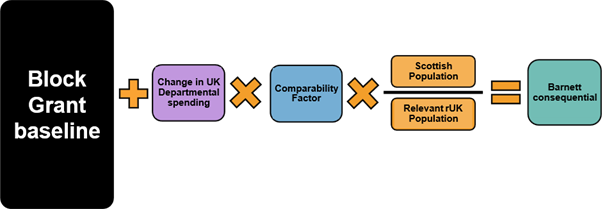
For example, imagine that the UK Government decides at one of its Budgets to increase spending on the NHS in England by £1 billion. The NHS is a programme of the Department of Health and Social Care, which is devolved, and therefore has a comparability factor of 100 per cent. It is an England-only programme because Wales and Northern Ireland also have their devolved health services, so we look at Scotland’s population as a share of England’s (approximately 9.8 per cent). The resulting number, £98 million, is the Barnett consequential from this UK Government decision. The Scottish Government can then decide what it does with that money. .Watch the “How is the Scottish Budget funded?” video below to find out more about the other sources of funding.